
When Patient Data Conflicts with Insurance Records
Our client is a US-based network of urgent care clinics operating under a “today-for-today” model, meaning they allow patients to walk in without prior appointments. With the company’s competitive advantage being based on the aforementioned operational model, the network found it critical to automate the patients’ insurance eligibility verification system which then consisted of heterogeneous platforms that did not communicate with each other.
With a specific business focus on fast patient throughput, the company’s priority still boiled down to maintaining strict healthcare compliance and operational efficiency. Therefore, they were looking to build a scalable internal system that would improve patient throughput and operational efficiency, especially reducing processing time per patient and optimizing personnel productivity, through the centralization and automation of the insurance records processing across its chain.

Platform Stability During Rapid Platform Updates
- The insurance record processing automation was needed to accelerate patient check-in flow, improve pricing transparency, and stabilize cash flow. All together, it should have enhanced the network’s aptitude to deliver on its “today-for-today” promise to its existing and, furthermore, prospect patients. However, several technological discrepancies prevented them from reaching these goals.
- Key challenges included:
- •Manual Insurance Verification Process: Front desk staff manually collected patient data, navigated dozens of insurer portals, called payers, calculated benefits, and determined out-of-pocket costs. This significantly delayed patient processing and pricing clarity.
- •Disconnected Systems: Patient data lived in Experity, while insurance information existed across 37 insurer portals and clearinghouses such as Availity and OneHealthPort. What is more, case tracking was handled in Google Docs. None of these systems communicated with each other, creating inefficiencies and redundancy.
- •Complex & Fragmented Insurance Landscape: Insurance portals varied by federal and state levels, often with inconsistent naming. Some insurers allowed portal automation, others required phone calls, and government insurers frequently restricted automation. Staff needed weeks of onboarding to learn these systems.
- • High Administrative Costs & Human Error: Manual calculations led to invoice disputes and billing inaccuracies. Constant staff turnover meant constant retraining. The seven-person insurance team generated substantial overhead while revenue collection remained delayed for months.
Custom Insurance Verification Automation Platform
SCIMUS developed a custom automation platform that fully replaced manual insurance verification while preserving the clinic’s familiar workflow.
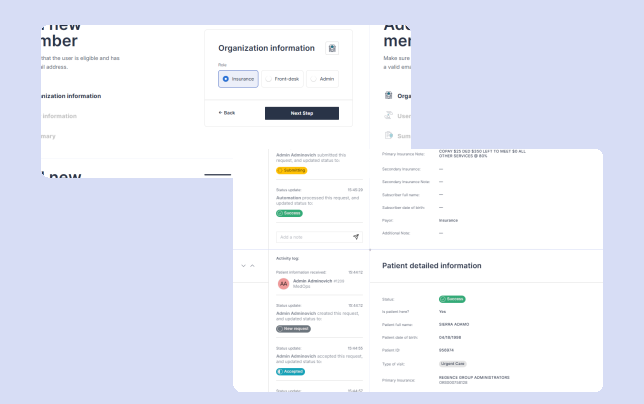
- Frontdesk Module. Staff enter or scan insurance cards. After submission, cases appear in the Insurance Team dashboard.
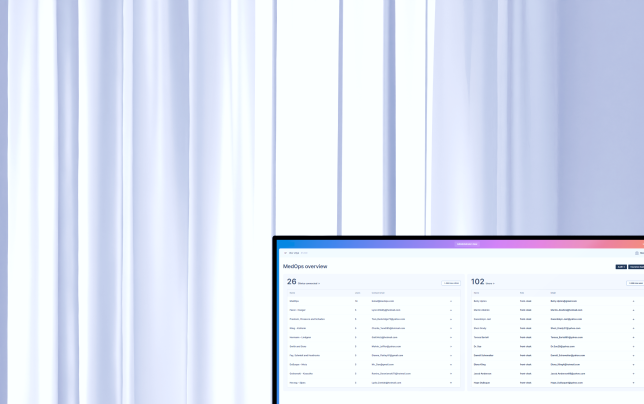
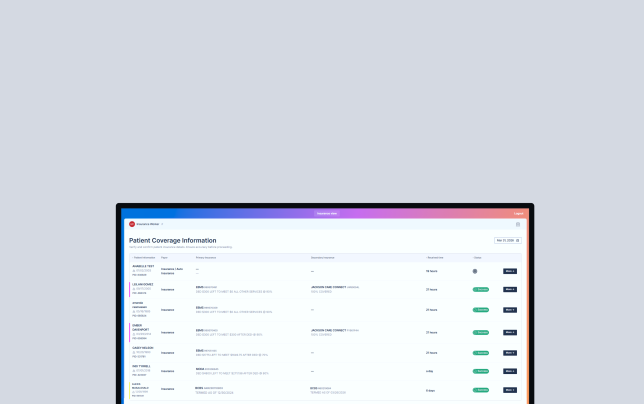
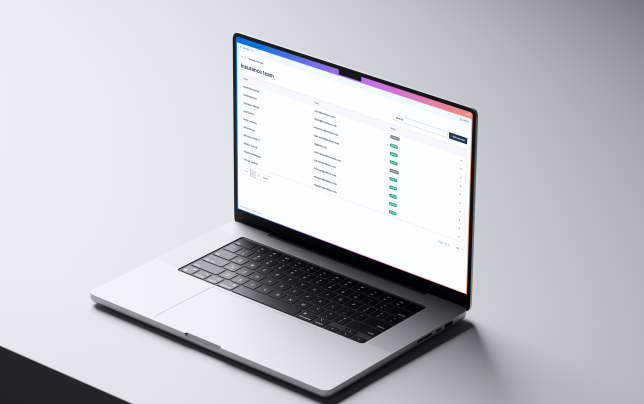
- Insurance Dashboard. Structured interface resembling their previous Google table. Team members assign cases and initiate automated searches.
- Automation Engine. The logic behind the insurance eligibility check boils down to a system that emulates real-user browser behavior, logs into insurer portals, checks the benefit data, and structures coverage details.
- Experity API Integration. Retrieves SSN, subscriber data, Member ID, and Group ID automatically.
- Manual Case Handling Logic. If automation is not possible, the system flags cases for phone-based verification.
- Admin Module. User management and clinic configuration.
The newly-built automation solution intelligently determines correct insurer branches (federal vs. state), structures benefit information, calculates coverage, and returns clear out-of-pocket estimates — all at the press of a button.
The Team Behind the Automation
A duly-designed — meaning cost-efficient and result-oriented — team was assigned to the project.
Agile Automation in a Dynamic Insurance Ecosystem

Migrate Without Migraine
From Manual Calls to Immediate Collections
Beyond numbers, the clinic achieved: faster patient check-in flow, reduced billing disputes, lower training burden, improved cash flow stability, and scalable internal infrastructure for multi-location growth.