
Streamlining a Multitenant eCommerce Intermediary Platform
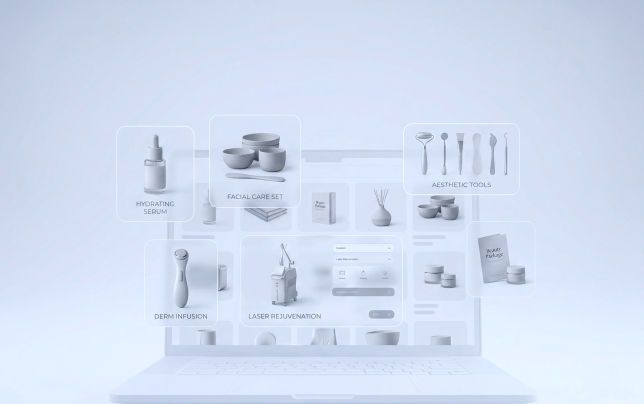
Operating out of Dallas, Texas, our client is a marketing and eCommerce software provider, specializing in digital solutions for medspa, aesthetics, and plastic surgery practices. While providing “shopping cart” capabilities for online stores on their platform — based on Magento and customized for the aesthetics and life sciences industry.
Nonetheless, even after years of intense business development, the company would approach each new store set up manually, which required at least three weeks of brute development force. Thus, the platform’s new potential tenants were repelled from doing business with the platform. They were looking for a tech partner to offer a vision for turning the new shops onboarding and customization process pretty much instant.

Business Objectives & Technical Challenges
- Our client was looking to render its core platform as the fastest “go-to-market” solution for the prospect tenants. Nonetheless, the platform’s outdated architecture, prone to performance and security issues, coupled with 2-3 week manual store deployment cycle, prevented them from expanding and streamlining business.
- Hence, the company wanted to modernize their eCommerce platform and migrate to scalable infrastructure, but multiple technical barriers stood in the way.
- Key challenges included:
- 1. Slow & Manual Store Delivery
- Each new online store required 2–3 weeks of brute-force development. With 150 stores in service, this created bottlenecks, client dissatisfaction, and limited scalability.
- 2. Outdated Architecture on Dedicated Servers
- Stores were hosted 30 per server (“box”). If one practice ran a high-traffic promo (email blast), all stores on that server slowed down. Maintenance or restarts caused complete outages across multiple practices.
- 3. Failed Magento Upgrade Attempts
- The existing team lacked the technical vision to properly upgrade Magento versions. Migration attempts caused quality issues, unstable deployments, and unpredictable timelines.
- 4. Security & Data Isolation Risks
- Shared infrastructure increased the risk of data commingling between practices — unacceptable in a healthcare-adjacent environment..
- 5. Uncontrolled Cloud Costs
- Attempts to move to cloud infrastructure resulted in architectural confusion and escalating AWS bills without achieving reliable scalability.


Cloud-Native Magento Commerce Ecosystem for Aesthetics
We transformed a manually delivered commerce product into a scalable, cloud-native platform capable of near-instant store provisioning. In order to make the store creation shift from a 3-week development cycle to a near-instant, repeatable deployment process, the SCIMUS team:
- – Automated migration testing using Selenium to detect upgrade issues early.
- – Carried out full automation of data transfer between legacy and upgraded Magento versions.
- – Established a cloud-native infrastructure on Amazon Web Services with containerized architecture.
- – Introduced store-level isolation: each practice runs in its own Docker container with a dedicated database.
- – Orchestrated Kubernetes for scaling and resilience.
- – Developed a self-service interface for practice owners to manage stores.
- – Automated onboarding workflow for new practices.
- – Centralized SKU database with manufacturer images and descriptions.
- – Introduced a reusable promo (email blast) library for campaign automation.
A Cross-Functional Team Focused on Scale & Stability
A duly-designed — meaning cost-efficient and result-oriented — team was assigned to the project.
Two-Year Phased Transformation Toward Touchless Delivery

Ready to Turn Magento Into a Scalable SaaS Engine?
SCIMUS builds cloud-native, containerized commerce platforms that scale predictably and reduce operational overhead.